| Date of Report: Monday, 7th September 2026 |
|
Name: Niel Malan Email: nmalan8@gmail.com Phone: 064 517 3811
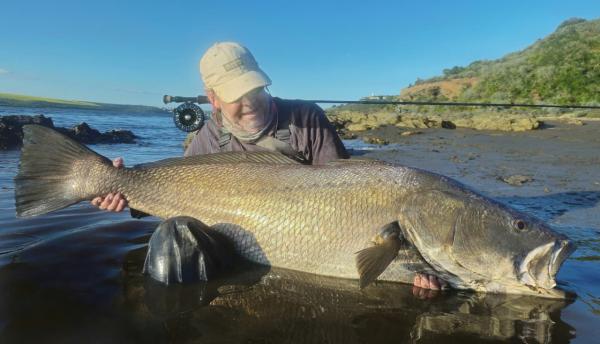
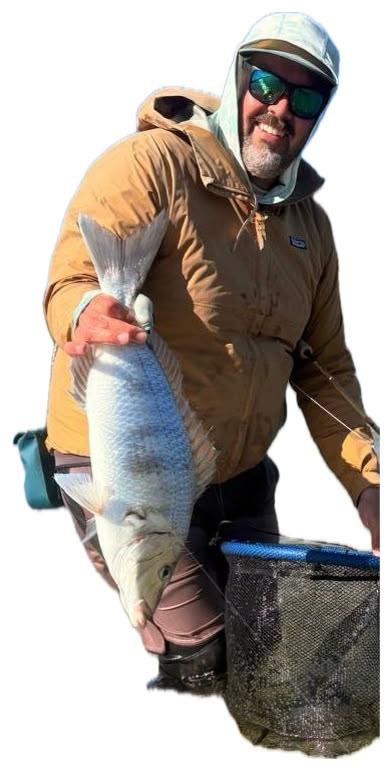
General: This report covers the period from 1 June 2026 to 31 August 2026. What a hectic period! This winter has been exceptional in many ways, including two severe flooding events that reshaped the Garden Route’s estuaries and rivers and left many of us fishless for several weeks. Willie Van Wyk summed it up nicely “Spesiaal vir jou FOSAF report: Ek het fokol vis gevang vir 2 maande nou al” (English: The fishing has been tough). Despite these minor setbacks several great events have also been held as will become clear below. Then there was the fishing – despite the floods, dirty fresh water effecting our estuaries, rivers and dams; and challenging cold spells some of the hard-core fly-fishers just could not stay indoors any longer and decided to “just go and have a quick look, or at least go and have a few casts” (after all, one can only tie so many new flies). For those fly fishers it was mainly hard work, but some of them were rewarded with exceptional results. None so more than our modest reporter from Witsand that regularly “klaps” the fish in the Breede estuary and it’s coastal fringes (even when he was supposed to look after his grandkids – but that is another story). Without further ado, let me show you the beast of a Kob that Mike Dohlhoff, ably assisted by Chris Cawood, managed to land from the shore after fighting it for about an hour. It really was a fish of a thousand lifetimes!
Fig 1. Mike Dohlhoff with his exceptional beast of a Kob! Mike did not include the following text in his report, but I am sure he will forgive me for sharing this: “…it was without a doubt the best fish I have ever caught in my life. It was, ja, unreal. It took an hour to land. It took 150m of backing on the first run and nearly spooled me and I managed to turn it and got the fly line back on the reel and then it took about 120m on the next run, but I eventually got it. We taped it at 150 cm – on the (ORI Fish) app that is 36 kg, but it was a really thick fish …. I think it was bigger (heavier) than that ……”. So guys and girls, just shows you that even when the conditions are kak (English: not nice) and the going gets tough the tough gets going. Give that man a Bell’s! Well done Mike – you are a real Kob Whisperer! See more in the Breede River section below.
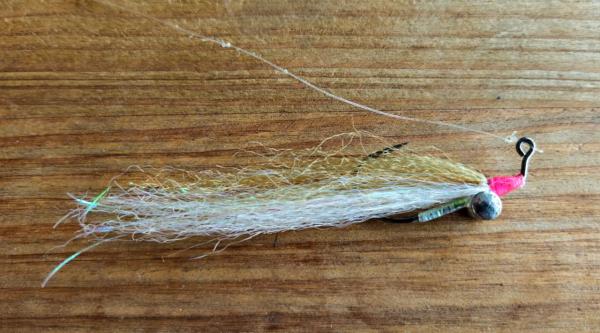
Fig 2. Mike’s 4/0 jig-hook Kob fly – note the damage to the leader after the epic fight.
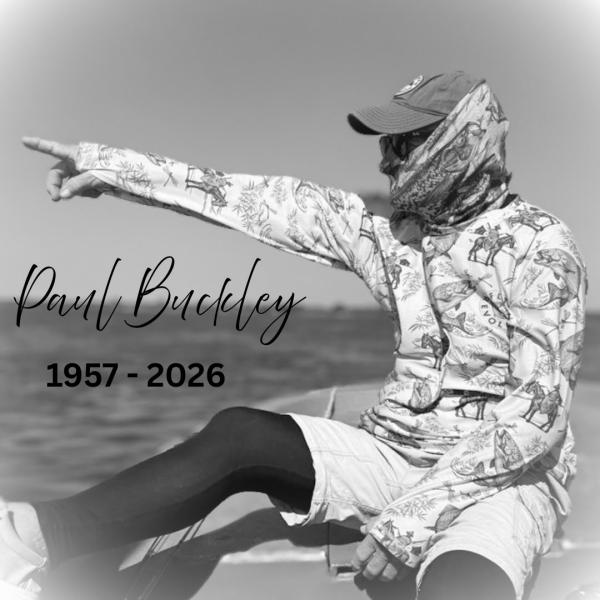
Fig 3. Paul Buckley. June sadly saw the loss of one of our beloved founder members Paul Buckley. He will always be remembered as a great friend of many here and across Southern Africa. GRFF gave Paul a send-off which was one of four memorials, we will miss you. Matt Zambetti reported on the last GRFF Event: “That’s a wrap on our meet for July! A really insightful and energetic talk on White Steenbras from Jessica Seath (Programme Manager at the Knysna Estuary Research Foundation) and a promise to come back next year and share some results of her research. This was followed by a moving celebration of our friend Paul where we all raised a glass and made merry in his memory. Thanks to Sirocco, Jessica, Angus, Cornel and everyone who was involved in making the evening memorable. There was also a great contribution to the new library located at Chris Wood’s office so come down and leave a book or take a book in the spirit of sharing” (GRFF Library open on Thesen Island. Bring, swop. Open Monday to Friday 08h00 - 13h00). Several books and magazines have been promised by members, and it looks like we will be out of space soon!
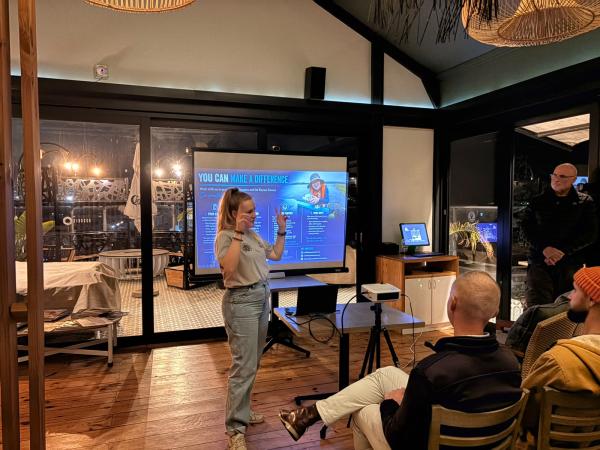
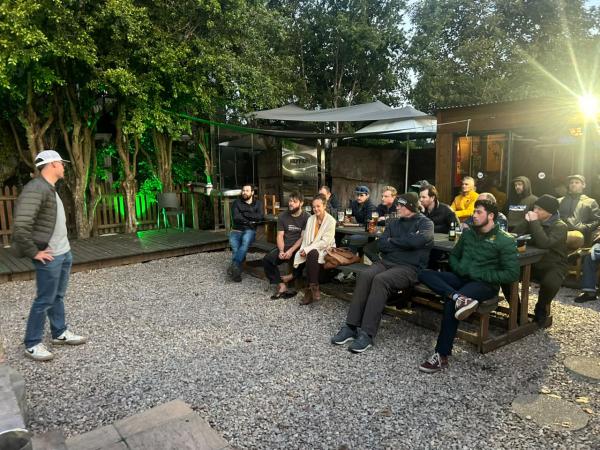
Fig 4. The crowd listening attentively to Jessica’s White Steenbras talk.
Fig 5. A small, but lovely, start to the growing GRFF Library.
Matt continued: “We will be looking forward to the Raw African Unfiltered Fly Fishing Film Festival (RAUFFFF) which the Mission is hosting at The Hollow at the end of August as an opportunity to gather so don’t have another winter meet planned as yet. But come September with the weather warming up we will start to plan some more outdoor-oriented get-togethers”.
Fig 6. The RAUFFFF logo. So what is this? Over to Matt Kennedy: “If you didn’t know by now, RAUFFFF (pronounced ‘rough’) is The Mission’s Raw African Unfiltered Fly Fishing Film Festival Touring South Africa in August 2026, The Mission will be holding screenings in Cape Town, Durban, Hilton, Johannesburg, Pretoria, Paarl and Knysna”. “What makes this one different? … While we love pretty much all fly fishing films, we have heard the feedback over the years from South African audiences, asking where the African fly fishing films are. That’s what got The Mission thinking – why don’t we make our own, African homegrown fly fishing film festival….The result? RAUFFFF …. an entirely new entry to the world of fly-fishing film fests… films that are almost all … about African fisheries, and/or by African filmmakers”. By the time you read this report the Knysna RAUFFFF event would just have been concluded. Chris Wood summed it up nicely: “What a night! Proper local fish porn, a brilliant mix of quirky SA flavour, fly-fishing adventure and some incredible conservation stories. …. some of the most insane Leerie eats caught on camera! We have some seriously talented filmmakers in SA and it was great to see our own Garden Route filmmaker Si Kay’s submission as well. It was a fun night out, great gees and plenty of laughs. Well done to The Mission team and all the film makers!
Fig 7. The new Tips on Tap logo – somehow it reminds me of my varsity days when the Old Brown Sherry made you do weird things. Never mind, let’s not go there. Then, sjoe, there was another GRFF initiative started during the reporting period, “Tips on Tap” was started by Matt Potgieter. See, this is what happens when the area gets flooded out and people need an excuse to get together and have a few cold ones. What is this all about? Over to Matt Potgieter: “A relaxed monthly gathering for anyone who enjoys fly fishing - or wants to learn more. The idea is simple: get together, have a beer, share stories, ask questions, learn new skills, and connect with other anglers in the Garden Route. Whether you're an experienced angler or just getting started, there will be plenty to learn, discuss, and take away from the evening”. During the opening event, Luke Van der Heever shared some of his insights from his three years as a professional fly fishing guide in the Seychelles. He talked about the lessons he's learned guiding on some of the world's most iconic flats, the techniques and mindset that consistently produce fish, and how many of those principles can be applied to targeting species here in the Garden Route. The event was a huge success and more will follow. Read the full report at the end of this report. The next event is on 16 September 2026 in Sedgefield. Thanks Matt! Matt Zambetti informed me that: “Garden Route Fly Fishing is planning a few events over the coming months. We have started hosting monthly Tips OnTap sessions driven by Matt Potgieter. We are also planning a bass day at Portland Manor for September and a trip to Calitzdorp to try for Smallmouth Yellows in the near future as well”. While the fishing slowed down for most of us over the winter period, others like Chris Wood: went to check out new offerings at the SAFTAD ((South African Fishing Tackle Agents and Distributors) Show, a trade only expo. Apparently Stealth has added a new rod, The Rhythm, which he will get a sample to use on his day trips. Chris said that: “The Catalina and Tanzanite Rod/Reel offerings will remain. Also checked out the Watamu clothing updates and some awesome coolers that are already available at Prawnstar. Fishing for me has been non existent but a couple of sessions planned in September and a Jolifly mission in October. Back on the Zambezi in November/December”. Others, like Deon Stevens decided to fish a bit further afield: “Nothing to report as yet. Got some good fish, but no trophies at Ed Clarke's two dams on the Bird River. Highlight was getting snowed in! Expect activity on Garden Route to pick up once Boks wins Rugby’s Greatest Rivalry soon. In the meantime, van der Kloof Dam and a possible trip to Rhodes until bookings start again in late September. Till next time, tight lines. GARDEN ROUTE FLY FISHERS MILESTONES:
FIRST (GARDEN ROUTE) SALTWATER FISH ON FLY:
FIRST GARDEN ROUTE SPOTTED GRUNTER ON FLY:
NEW SPECIES OF GARDEN ROUTE FISH CAUGHT BY MEMBER (IF NOT ALREADY CAPTURED ABOVE):
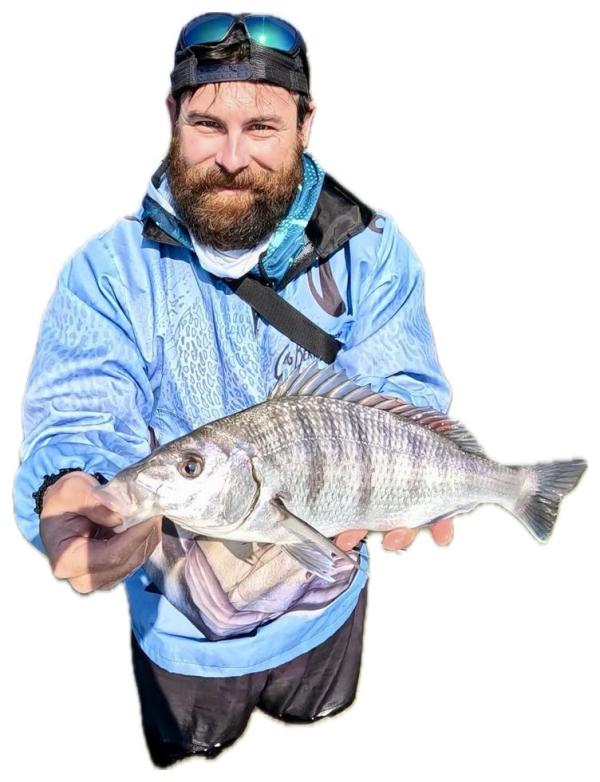
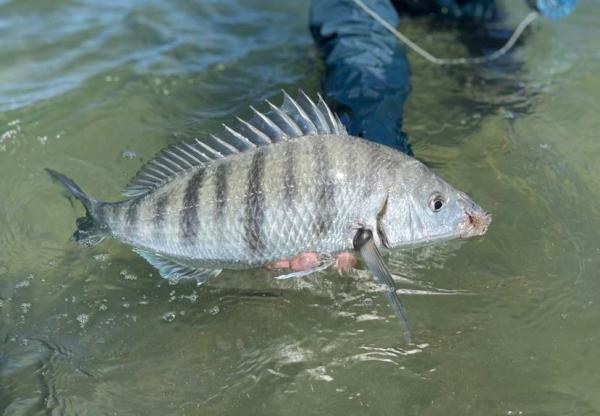
Fig 8. A legless Matt Zambetti showing off his first fly-caught White Steenbras. Nice one Matt!
Entry into the 50+ Club [Ed: 50 fish or multiples of 50 of a specific species from the Garden Route]: Please send me your details for inclusion in the next report.
BELOW IS SOME FEEDBACK PROVIDED BY MEMBERS RELATED TO THE SPECIFIC SYSTEMS: As always, thanks to all the members that have kindly offered information and stories. Without you this report would have been very short and feeble. That said, there are still many people that are not sharing their catches and info. This may also be partly as a result of them not wanting to share sensitive information. To accommodate for this a new “under cover” section was created – see section 15 below. Let’s hope this will help and that they will also soon come to the party.
1. BREEDE RIVER ESTUARY (WITSAND/CAPE INFANTA): Our regular correspondent Mike Dohlhoff reported: “Hi Niel. Despite my concerns as to the effect of the flood in May, the river seems to have stabilized. Many of the pre-flood regular spots have changed significantly and those visiting the river, in particularly on the Infanta side, will notice that besides the many dead trees and structures that were washed down, the popular bays i.e. Grunter Bay, Kontiki Bay, Shark Rock and The Golf Course are heavily mudded up and although the prawn holes have returned, wading these spots is not a pleasant experience with very soft often knee deep mud in abundance... this has not changed much in the last 3 months but I am sure in time it should firm up. The Kob spots seem to be less effected as they are mostly near rock which are swept clean by the stronger tides. On this note the winter has been surprisingly productive on the Kob front with good numbers on most sessions when the fish were located. This proved to be a challenge at times as the stronger tides near spring seemed to spread the fish over a much wider area, making them more difficult to locate. During neaps fish were more concentrated in the lower reaches of the river. Average size ranged 40-60cm with a good few of 70-80cm. Although the flood put massive amounts of water into the system over a short period in Autumn, the rest of the winter has seen well below average rainfall in the entire catchment, hence the almost never-ending season that we experienced. Blacktail off the rocks were available on most outings when looking for them.
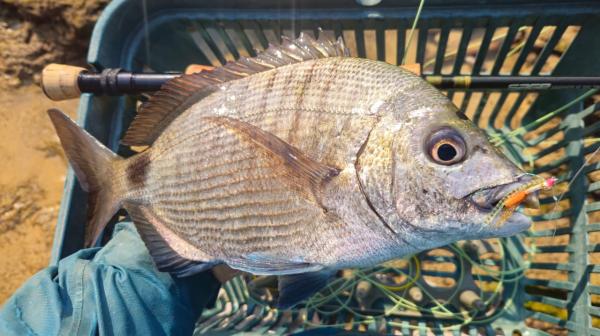
Fig 9. One of Mike’s many fat Blacktail landed during the reporting period. Water has started warming and over the next few spring tides I am sure Garrick and Grunter should start appearing in numbers. The bait guys are getting some good fish out of the channels, but the fish have yet to move into the shallows. A surprising number of bycatch Grunter of decent size were also caught during the winter Kob sessions.
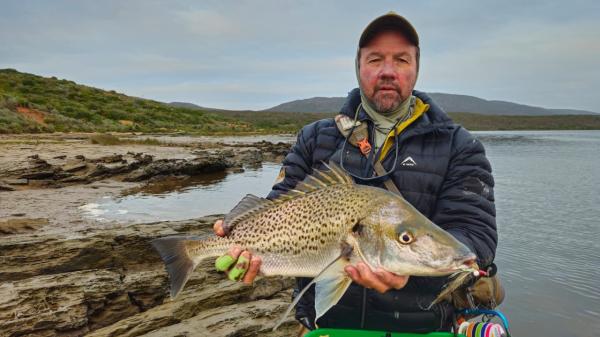
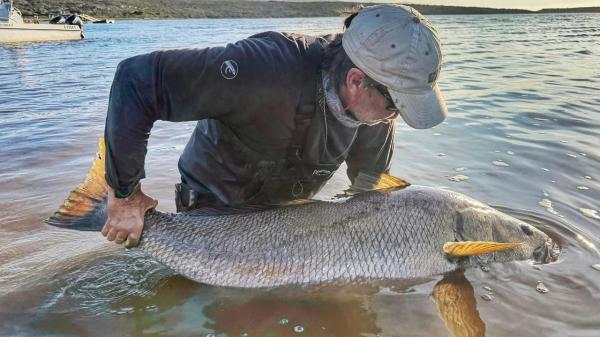
Fig 10. Chris Cawood with a decent Grunter that decided to chow the Kob fly. On a personal note, I was very fortunate to catch the fish of my life on one of the winter outings...years of perseverance finally paid off with a beast of a Kob coming to hand. The full story of this epic encounter is for another day, but for now I feel truly grateful to have had this opportunity in the company of a few friends who were there to help. I got lucky but I will take it! The fish which was hooked from the side took just under an hour to land, it was taped at 150cm and after reviving it for a short while, swam away strongly....what a privilege it was.”
Fig 11. One last look before Mike’s great fish swims off.
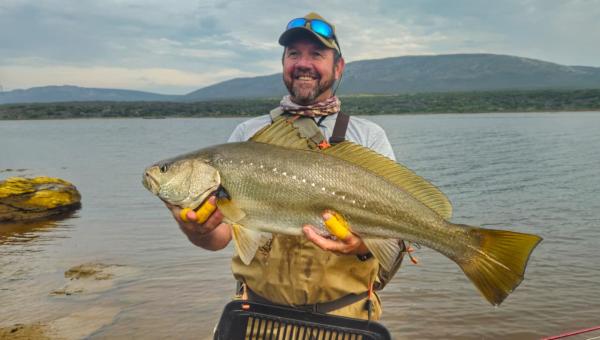
Fig 12. Mike and Chris Cawood caught an assortment of fish during the reporting period. No wonder that Chris has this beautiful smile! Niel Malan added: “Awesome fish and awesome report Mike. Much appreciated and well done on your fishes, including a fish of a 1000 lifetimes!” He also added that he visited Cape Infanta for a short stint and managed to catch a small Grunter and two decent Kob.
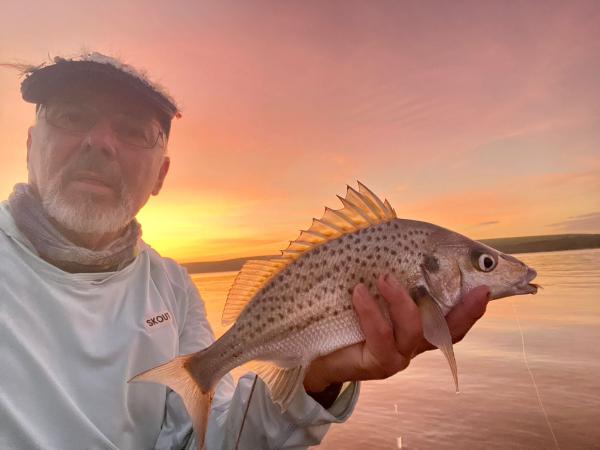
Fig 13. Niel’s small Grunter caught just before braai-time.
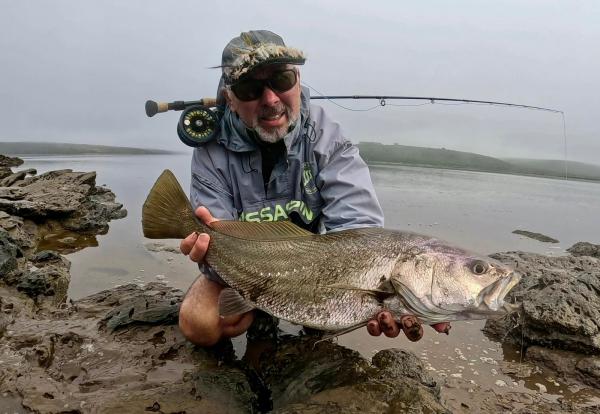
Fig 14. One of Niel’s Kob and demonstrating the dreaded “langarm pose”.
There are also unconfirmed rumours that other fly fishers landed some kob, including one of 108cm. Unfortunately, no responses for details were received from them by the stated deadline.
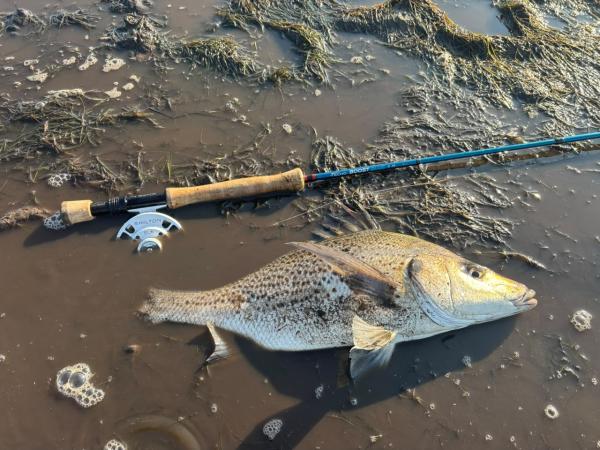
2. GOUKOU RIVER ESTUARY (STILBAAI): Our regular contributor Philip Meyer said that: “Hi Niel, hier is darem so ietsie, glo vir die volgende report kan ek jou meer info gee. Pappa wil hierdie seisoen baie meer hengel”. Jy beter Philip! “At the time of writing this report, the Goukou is a weak coffee with milk colour. We had some rain this past Thursday (3 September), and on Friday the river came down. I expect the river to clear within a week, and I trust the fishing will pick up if conditions remain stable throughout September. I fished two sessions at the end of August, picked up a Grunter, and missed some more. Water temperatures hover around 15–16 degrees Celsius, so it's still a bit on the chilly side for the Grunters. There are also rumours of small Kob being caught on lures, and I will be targeting some Kob during September and October. There are a few different fly patterns in the vice this year, which will be tested soon, and I hope to give positive feedback at the time of the next report”. Thanks Philip!
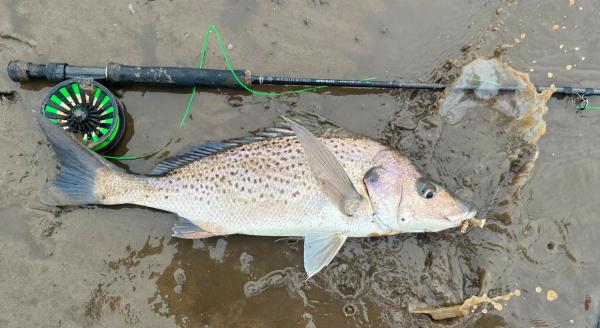
Fig 15. Philip’s Grunter that succumbed to his sub-surface prawn imitation. Michael Hainebach liked this pic – “Classic photo with the splash!”
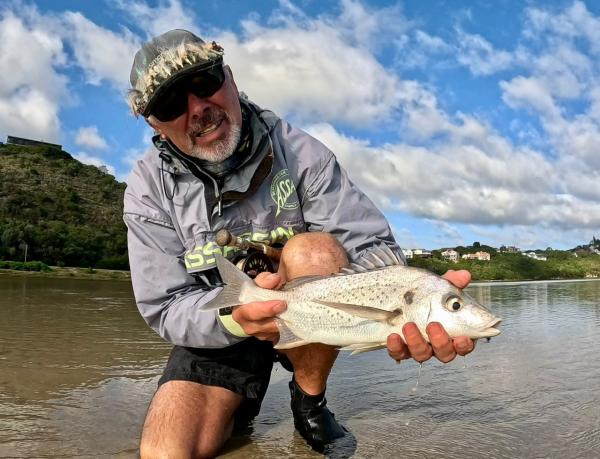
3. GOURITS RIVER ESTUARY (GOURITSMOND): Nobody reported fishing this system during the reporting period. 4. KLEINBRAK RIVER ESTUARY: Nobody reported fishing this system during the reporting period. 5. GROOTBRAK RIVER ESTUARY: Benno Klinck said that: “Hi Niel, conditions weren’t ideal in June, with quite a bit of freshwater around, but the fish didn’t seem to mind too much. I managed to find a couple of tailing Grunters in between spooking a few Kurpers (Tilapia). Had a couple of close opportunities, but only managed to land the one Grunter. Also caught a couple of Stumpnose along the way.
Fig 16. Benno’s first post-flood brown Grunter.
Fig 17. Benno asks if anyone can recommend a person that can service a Shilton reel? And what glue he can use to add a tail to his Grunter? July was a different story, with the fish seemingly nowhere to be found. They only really seemed to return this last week in August. Hopefully, with some clearer water coming through, the conditions will pick up a bit and the fishing will improve”.
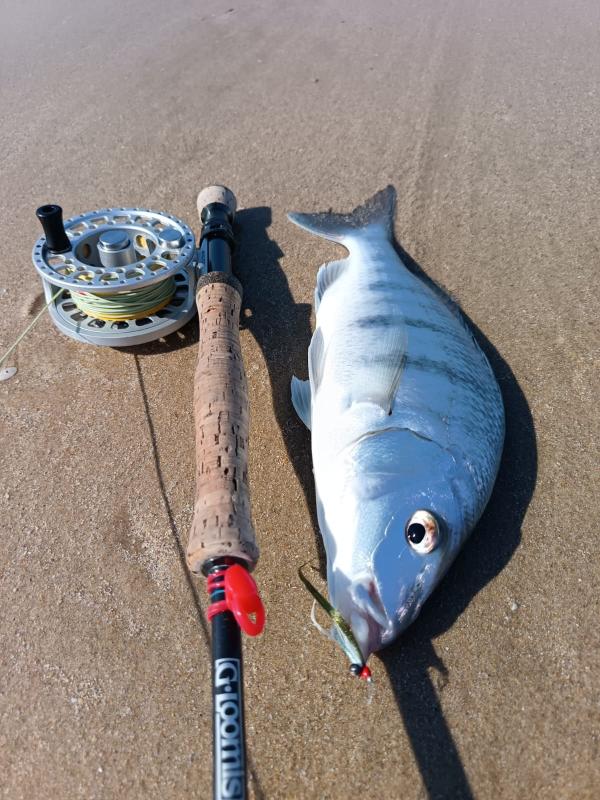
6. TOUWSRIVIER ESTUARY (WILDERNIS): Nobody reported fishing this system during the reporting period. 7. SWARTVLEI RIVER ESTUARY & LAKE (SEDGEFIELD): No information received from the regular reporters, but Niel Malan mentioned: “Quick stop at Sedgefield on the way back from the airport. Water still very brown and outgoing tide, but decided to take a stroll. Saw 1 Grunter… and caught it on my Goby Fly. About 45cm. First post-flood Grunter, so happy #228”.
Fig 18. Niel’s first post-flood Grunter.
8. GOUKAMMA RIVER ESTUARY: Nobody reported fishing this system during the reporting period.
9. KNYSNA RIVER ESTUARY: Luke Van Der Heever reported: “Hi Niel, I hope that I haven’t missed the report. My fishing was limited to 10 days’ worth over the past 2 months for various reasons. Fishing in Knysna has been very tough in general but should be picking up now. Landed maybe 15 Southern Mullet on an olive Charlie and one Steenbras on a crab over 6 sessions, Steenbras were only pushing up very late and for very small windows. I think the floods had a major impact on the winter fishery with regard to fish behaviour but should result in an incredible summer season! What is most interesting is how quiet off-shore fishing is, not because there is no life but rather too much of it! There are football fields of mackerel from the Knysna Heads all the way to Wilderness and I’m sure all down the coast too, yet no hungry predators. Maybe they all have full bellies!” Indeed Luke, but sooner or later they will get hungry again.
Fig 19. Luke’s chunk of a White Steenbras checking out this damn crab that bit him/her.
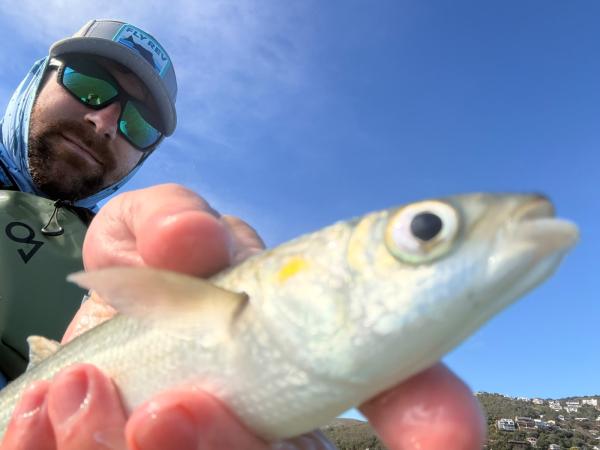
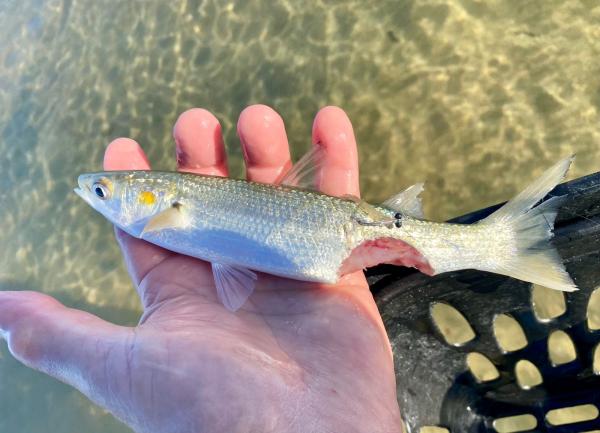
Matt Zambetti went looking for fish, but finding none had to switch to Plan B. He added “Always have a couple of mullet flies ready in case you don’t find anything else, such fun”. He landed 2.
Fig 20. Matt’s Mullet selfie. Rumours have it that Smokey, The Ghost, mentioned that he had some reasonable winter success managing to land some White Steenbras and Cape Stumpnose. Apparently he has not seen any Grunter around. Then what was this about him foul hooking a small fish that nearly spooled him? I suppose we will never know – sounds like a true ghost story. Apparently his reel was smoking so badly people could smell it in Plett. Or was that just him slaaning a dampie? News just in from Smokey himself: “My report - caught maybe 10 Steenies and a few Stumpies. Conditions haven’t been great and when the conditions have been good the seal has been around causing kak (English: chasing the hell out of the fish). Also lost a very big Steenie that I couldn’t stop, maybe I need to fish heavier fluoro?” Ah, so now we know. Better luck next time.
Fig. 21. Finally a wee glimpse of Smokey the Ghost with one of his Steenies.
10. KEURBOOMS AND BITOU ESTUARIES (PLETTENBERG BAY): Very few flyfishers fished here after the floods. Niel Malan added: “I was away during the reporting period and only fished here 8 sessions, some quite short (just to see if the fish had returned). Niel mentioned that he went out less than normally and most of the time he did not see any decent fish so decided to target the Southern Mullet when they happened to be around. These are extracts from some of his notes: “Just an update on Plett - Poortjies area between the caravan park and Lookout Restaurant / Milkwood Manor: Went out yesterday on pushing tide to see if fish have returned. Lots more sand than before the floods. Water clear enough to sight-fish. Unfortunately no fish seen apart from good numbers of Southern Mullet that congregate in the channels next to the sand banks when the water rushes in. Got 14 on my Goby Fly. That is 27 on it in the last 2 sessions. Mullet were 25-35 cm. On my Goby fly. Foul-hooked no. 14 and looks like a Shad tried to chow it’. They preferred a very fast short strip”. “Covered 6 km, but did not see any fish.”
Fig 22. Niel’s small foul-hooked Southern Mullet that got taxed by a Shad. “Then for the last 2 sessions of the reporting period I went searching for fish upriver and found some juvenile Garrick. I ended up with 12 Garrick in the 40 – 45cm range, lost 2 flies to Shad (one a large one) and got snapped off on the take by a big fish”.
11. GROOT RIVIER – NATURE’S VALLEY: Nobody reported fishing this system during the reporting period.
12. KROMME RIVER ESTUARY: Marius Rousseau, our regular respondent, reported that: “Kromme has cleared up and happy days are here again "lekke, lekke " as Niel would say”. Mooi Marius, lekke lekke! The Kromme has produced the odd nice Grunter, a Yellow bellied Sea Snake was spotted and first Steenie for Ian Gaylard on a special fly he created. With all the rain the Kromme River has not been consistently clear and fishing should improve once it finally clears up for an extended period. To add to my previous information, the Kromme is still dirty but has given us a few windows in between where some fish could be taken on fly, latest victim was a young Steenbras. The river has cleared but more rain is expected from Sunday and we are hoping for the best.
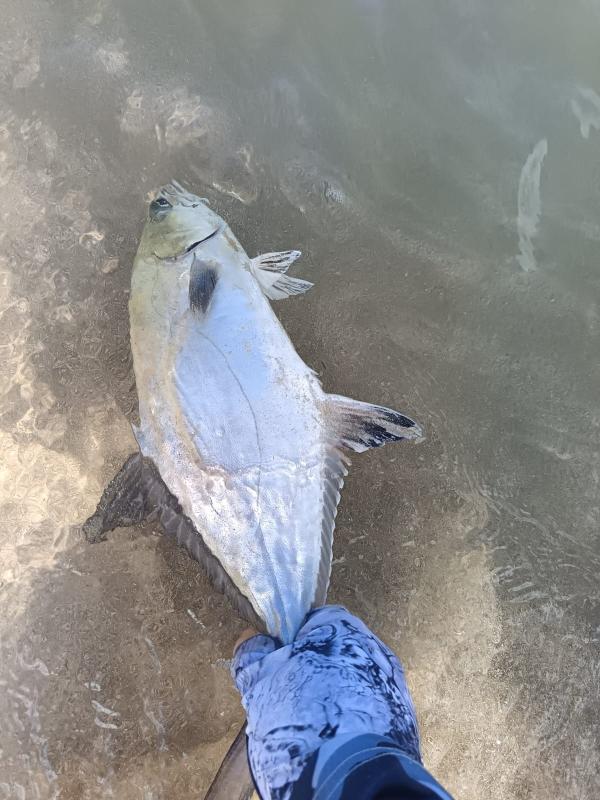
Fig 23. Marius’s Garrick.
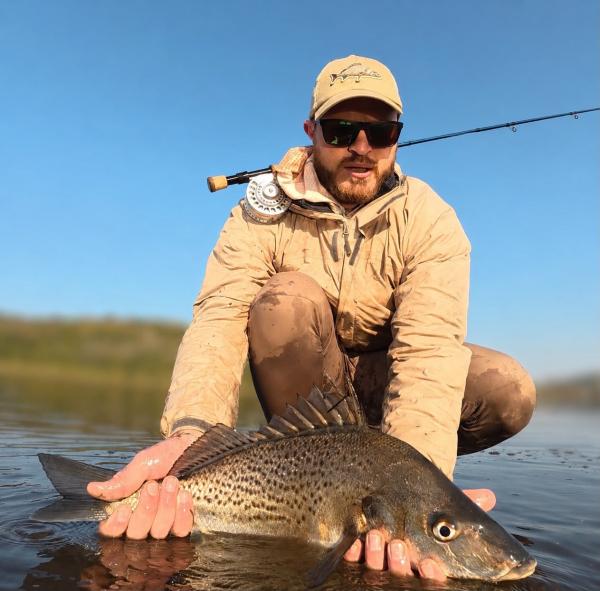
Fig 24. Marius’s Grunter.
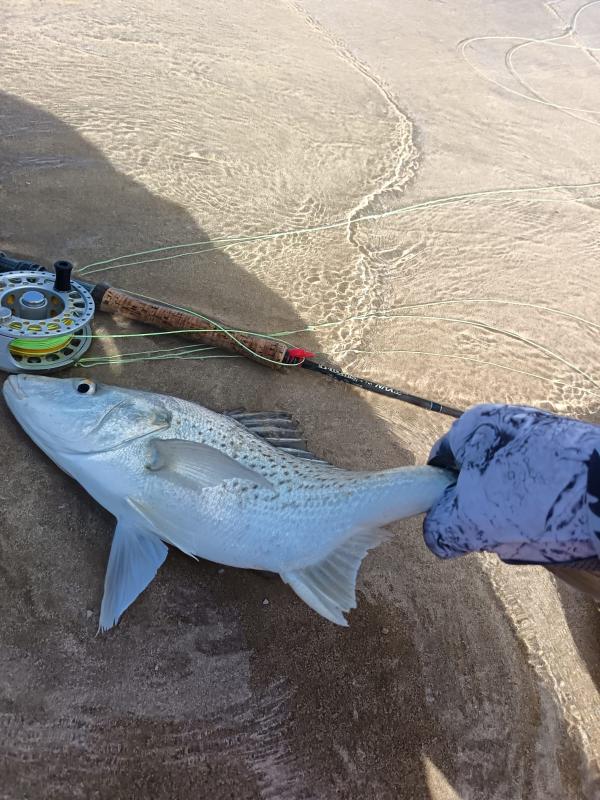
Fig 25. Marius’s White Steenbras that took an olive over white Clouser fly.
13. ROCK AND SURF: Mike Dohlhoff managed to catch several good sized Blacktail (see under Breede River section). 14. OFF-SHORE: Nobody reported fishing this system during the reporting period. 15. CONFIRMED CAUGHT IN THE GARDEN ROUTE, BUT IN AN AREA THAT IS TOO SENSITIVE TO DISCLOSE FULL DETAILS: This is a new section that has been added to allow for some sharing of information and highlighting the fly fishing potential in the Garden Route without disclosing the exact locations where the fish were caught. Normally this is because it might be a species that is endangered, can easily be impacted (especially by bait or throw net fishermen) or is in a tiny area with a limited carrying capacity. We certainly don’t want to see all catches being reported here, but this section will allow members some bragging rights instead of just withholding all information. If you read the reports here and you recognize the area, please keep it to yourself. I can also mention that sometimes if you read about the locations on Facebook, or Instagram, the mentioned positions might have been altered with good reason – it is Fakebook after all. Please send me your info and be sure it will be treated with due respect. 16. RIVERS: Nobody reported fishing this system during the reporting period. 17. STILL WATERS: Nobody reported fishing this system during the reporting period.
TIPS AND TAPS: BRINGING GARDEN ROUTE FLY FISHERS TOGETHER Matt Potgieter reports: “Tips and Taps is a new monthly gathering for fly fishers across the Garden Route. The aim is simple: to create a relaxed space where members of the local fly-fishing community can meet, share stories and learn from one another. Each gathering will focus on the Garden Route’s iconic fish species and the practical knowledge required to target them on fly. Topics will include leader setups, fly selection, tides, water conditions, fish behaviour and the lessons that can only be gained through time spent on the water. The first Tips and Taps gathering was held at Moonshine Diner in Sedgefield on Wednesday, 12 August. We had a fantastic turnout, with the evening beginning over cold beers, introductions and plenty of fishing conversation. Our guest speaker was Luke van der Heever, a Garden Route local who has spent the past three years working as a professional fly-fishing guide in the Seychelles. Luke shared some of the knowledge he has gained while guiding in the Indian Ocean and explained how many of those lessons can be applied to targeting fish here in the Garden Route.
Fig 26. Luke sharing some pearls of wisdom with GRFF members.
A central theme of his talk was the importance of patterning fish. Fish are often far more habitual than we realise, displaying recognisable feeding behaviours, responding to specific conditions and frequently operating within relatively small home ranges. By repeatedly fishing and observing a particular area, anglers can begin identifying these patterns and use them to make better decisions on the water. Luke also discussed the influence of water temperature, tides and timing. He explained that Spotted Grunters generally respond well to stable water temperatures and may become more active once temperatures have remained consistent for several days. Tidal movement is equally important because it strongly influences where and when fish feed. Understanding these changes helps an angler decide when to fish, where to position themselves and which areas are most likely to be productive. Luke also highlighted the importance of understanding the life cycles and seasonal movements of the species being targeted. Using Garrick as an example, he explained that these iconic predatory fish migrate northwards along South Africa’s east coast to breed during the winter months. As a result, much of the population leaves our local estuary systems during this period. Water temperature also influences their movements, and Garrick may enter estuaries along their migration route when ocean temperatures drop suddenly. They are generally more prevalent in Garden Route estuaries during the warmer summer months, when the estuary water is often warmer than the surrounding ocean. Understanding these seasonal patterns helps anglers determine when Garrick are most likely to be present and worth targeting. The discussion then moved to flies, leader setups and planning a session around the prevailing conditions. Luke advocated carrying a small selection of proven patterns that imitate the fish’s natural food sources, rather than an unnecessarily large and complicated fly box. The key is to carry each pattern in different weights—for example, the same pattern in three weight variations. This allows the angler to present the correct food imitation at the depth where the fish are feeding. The appropriate weight will depend on the fish’s position in the water column, the depth and flow of the water, and whether the fish are feeding over mud, sand, weed beds or another type of substrate. This approach keeps fly selection simple while still allowing the angler to adapt the presentation to different scenarios. Luke’s preferred setup includes a furled leader, which he values for its shock-absorbing qualities. The overall length and construction of the leader will, however, depend on the target species, conditions and type of presentation required. The recurring lesson throughout the evening was that there is no substitute for time on the water. Consistently fishing the same areas allows an angler to recognise how fish move, where they feed and how their behaviour changes with the tides and conditions. Developing this local understanding can make a significant difference to the chances of successfully targeting these fish on fly. Luke’s presentation ended with a valuable question-and-answer session before the evening returned to relaxed fishing conversations, shared stories and some excellent pizzas. The opening gathering captured exactly what Tips and Taps was created for: bringing the Garden Route fly-fishing community together to connect, share knowledge and learn more about the waters and fish found in our own backyard. A sincere thank you to Luke for sharing his experience, to Moonshine Diner for hosting us and to everyone who joined us for the first gathering. We look forward to building Tips and Taps into a regular meeting place for fly fishers throughout the Garden Route”. Excellent report Matt Potgieter, you captured it perfectly and I will add it as is into the next GRFF FOSAF Report - I might just add Luke’s suggestion of carrying 3 different weighted versions of every fly. Thanks again Matt.
For more GRFF info and interaction also see: “Whatsapp Group Invite link: https://chat.whatsapp.com/DOycPtfIdPCEJNRCAG2pn8
Garden Route Based Guides:
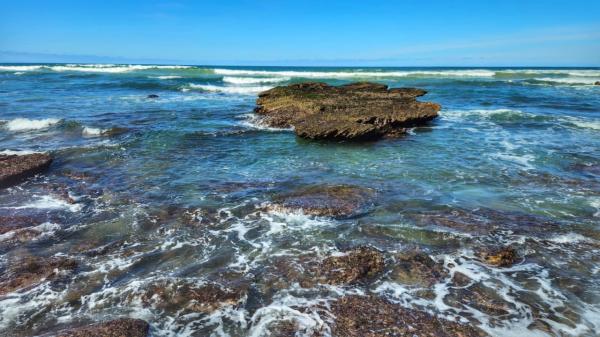
Fig 27. Some beautiful Blacktail gulleys. Thanks for sharing Mike Dohlhoff. |